

Authenticity Isn’t as Simple as “Being Yourself”
You haven't lost yourself. But you might have stopped paying attention.

At the beginning of each year, I choose a word to live by.
Not a goal or a resolution (because let's be honest, we all know resolutions tend to go down the pan pretty fast).
Just a single word that feels like an invitation for how I want to move through the months ahead.
Some years the word arrives easily. Other years it takes time.
And the word can always be changed if it no longer feels aligned at some point throughout the year.
This year the word that kept returning was authenticity.
Not in the way it’s often talked about online, as bold self-expression or saying exactly what you think at all times.
The version of authenticity that kept surfacing for me felt quieter and more subtle than that.
It had less to do with announcing who you are, and more to do with noticing the moments when you drift away from yourself.
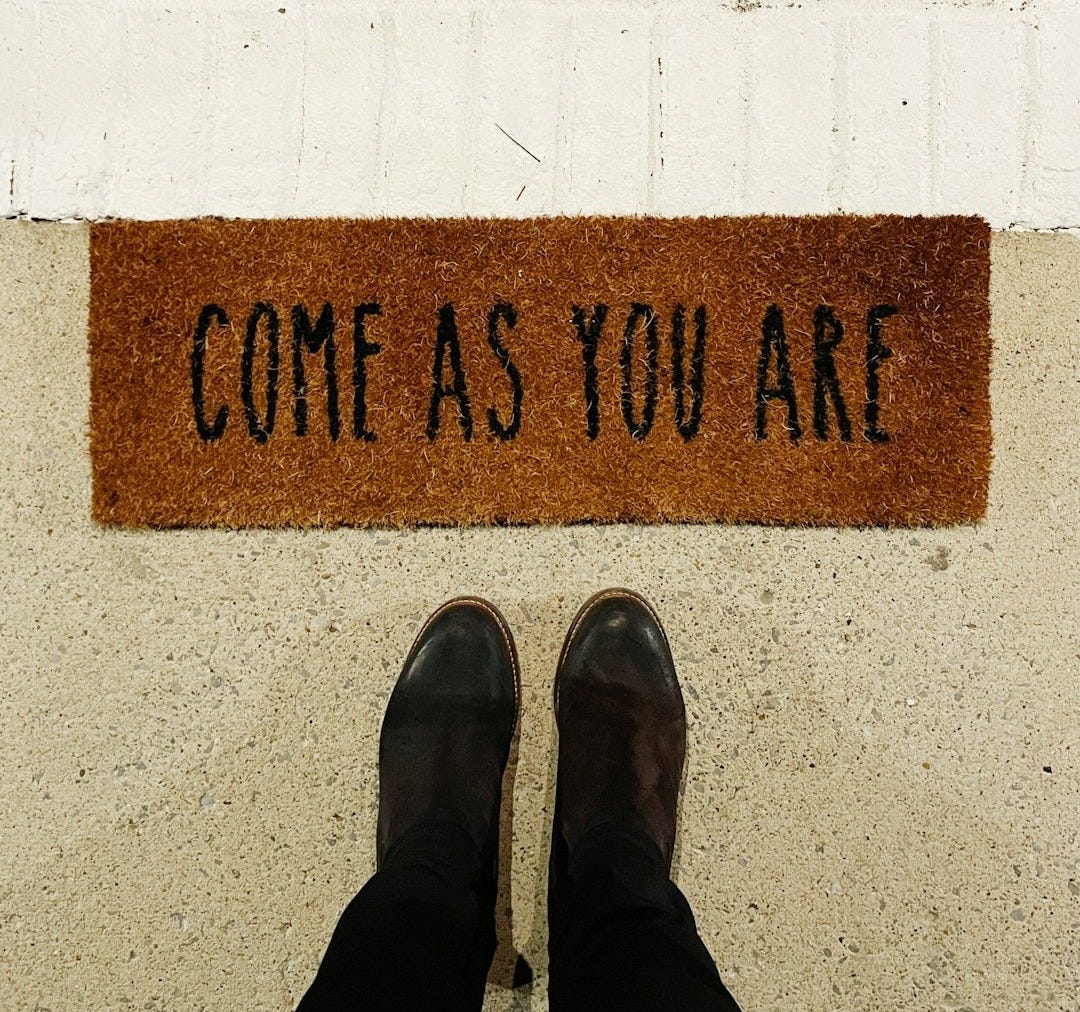
When Life Slowly Shapes Who We Become
Most of us didn’t consciously decide who we would become.
Over time, life shapes us in quiet ways.
We adjust to different environments.
We learn what helps conversations go smoothly.
We notice which parts of ourselves are easier for others to receive.
These adjustments aren’t usually dramatic.
They’re small shifts that happen gradually.
You learn to move through certain situations with a little more caution.
You soften parts of yourself that once felt more spontaneous.
You become skilled at reading the room before speaking.
None of this is inherently wrong.
In many ways, these abilities help us navigate the world.
But after years of adapting to different environments and expectations, it can sometimes become harder to recognize what actually feels natural for us.
Not because we’ve lost ourselves. But because we’ve simply grown used to moving through the world in ways that make things easier for everyone around us.
And over time, we can slowly forget who we are, who we want to be, and what lights us up.
Authenticity Isn’t Always Loud
When people talk about authenticity, it’s often framed as something bold.
Speaking your truth.
Being unapologetically yourself.
Standing out from the crowd.
But in everyday life, authenticity often looks far quieter than that.
Sometimes it looks like:
Saying a simple “I’m not sure that works for me.”
Allowing yourself to change your mind without needing to justify it.
Letting a conversation pause instead of rushing to fill the silence.
Admitting when you don’t have an answer.
Authenticity doesn’t always arrive as a declaration.
Often, it shows up as small moments of honesty that feel slightly unfamiliar at first.
Why Authenticity Can Feel Uncomfortable
One of the things that fascinates me about authenticity is how the body often responds to it.
We tend to think that being authentic will feel freeing right away.
And sometimes it does.
But other times it can feel surprisingly uncomfortable.
Your heart might beat a little faster when you say something honest.
You might second-guess yourself after sharing a genuine thought.
You might feel a moment of vulnerability when you allow yourself to be seen without polishing the edges.
This happens because our nervous systems are wired for belonging.
For most of human history, fitting into the group helped keep us safe.
For more on this, head to my article: The Labels That Quietly Run Our Lives
So when we step even slightly outside of what feels familiar, the body can interpret that as risk.
Authenticity isn’t dangerous.
But to a nervous system that has learned to prioritize safety and connection, it can occasionally feel that way.
Which is why authenticity often unfolds slowly.
Not as a dramatic transformation, but as a series of small choices that gradually feel more natural.
The Quiet Work of Returning to Yourself
When I realized authenticity was the word that kept coming up for me this year, it didn’t feel like a declaration.
It felt more like a question.
Where do I feel most like myself?
And where do I notice myself subtly shifting away from that?
Not in a judgmental way. Just with curiosity.
Authenticity, for me, isn’t about trying to become a more impressive or expressive version of myself.
It’s about paying attention to the moments when something feels slightly off when I’m speaking or moving in a way that doesn’t quite match what I’m sensing inside.
And gently adjusting course when I notice it.
Over time, those small moments of noticing begin to add up.
A Small Ritual: Noticing Where You Feel Most Like Yourself
If authenticity is something you’re curious about exploring, you don’t need to make dramatic changes.
You can start with simple observation.
At the end of the day, take a quiet moment and reflect on this question:
When today did I feel most like myself?
It might have been a conversation where you felt relaxed and unguarded. A moment when you were fully absorbed in something you enjoy. A stretch of time where you didn't feel the need to perform or manage how you appeared.
Notice what was present in that moment:
Where were you?
Who were you with?
How did your body feel?
Authenticity often reveals itself not through effort, but through ease.
By paying attention to those moments, you begin to learn where your system naturally settles into a sense of alignment.
Practicing Authenticity
I don’t expect authenticity to be something I master this year.
If anything, choosing it as my word simply means I’m paying closer attention.
To the moments when I feel fully present in my own life.
And to the moments when I realize I’ve quietly drifted away from that.
Not with judgment.
Just with the willingness to notice.
Because authenticity isn’t something we suddenly achieve.
It’s something we practice in small ways, over time, as we continue learning what it feels like to be at home within ourselves.
With love,
Courtenay-Sacred Wave Wellness
If this resonated, you can subscribe to receive more reflections and practices like this each week.
If someone you know would love the space we’re building here, I’d be grateful if you shared this post with them. Together, we’re growing a beautiful community. 💙
I prefer a quiet form of it too as it reduces the pressure of “being myself.”